
 IN2DATA 2026 | SPEAKER SPOTLIGHT
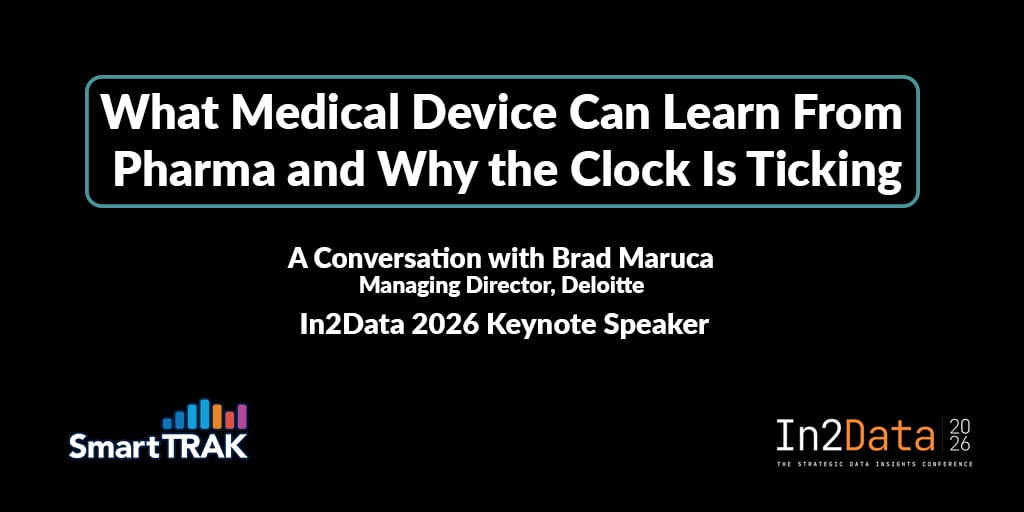
A conversation with Brad Maruca, Managing Director, Deloitte | In2Data 2026 Keynote Speaker
Pharma figured something out that medical device companies are still catching up on: data is not a byproduct of doing business—it is the business. From evidence generation to market access to commercial execution, the pharmaceutical industry built its entire infrastructure around the idea that intelligence drives outcomes. MedTech, for the most part, built its infrastructure around the device.
That gap is no longer academic. As AI and advanced analytics accelerate the pace of market access decisions, payer scrutiny, and competitive positioning, MedTech companies that haven’t invested in their data and intelligence capabilities are finding themselves at a structural disadvantage—not just against Pharma, but against better-prepared peers in their own markets.
At SmartTRAK’s In2Data 2026 conference—November 4 at The Gaylord Hotel in Dallas—Brad Maruca, Managing Director at Deloitte and former Divisional VP at Abbott Neuromodulation, will bring this conversation to the stage. His session, "Translating Industry Data Playbooks for MedTech," draws on deep cross-industry experience to give MedTech leaders a clear-eyed look at where the gaps are, what Pharma got right, and what companies need to do to close the distance.
The Pharma Playbook: Evidence, Economics, and Patient Lifetime Value
In the SmartTRAK blog piece he co-authored with Deloitte colleague John Jaeger, Brad outlined one of the most important strategic divergences between Pharma and MedTech: how each industry thinks about a patient.
Pharma operates on an annuity model. The patient’s journey doesn’t end at prescription—it continues through adherence, re-prescription, outcomes tracking, and long-term engagement. That philosophy drives everything from clinical trial design to real-world evidence programs to payer negotiation strategy. Pharma companies invest heavily upfront in evidence generation because the long-term economics of formulary placement and reimbursement security justify it.
MedTech, by contrast, has historically built its commercial model around physicians and procedures. Product innovation drives growth. Clinical relationships are primary. But that model increasingly runs into friction at the payer level—and it’s AI and data analytics that are sharpening that friction.
|
The Gap in Plain Terms
While Pharma has long harnessed the power of big data and advanced analytics to inform everything from drug discovery to market penetration strategies, MedTech has been slower in adopting these resources to their full potential. The result: a growing asymmetry in how each sector navigates an increasingly data-driven commercial environment. — Brad Maruca & John Jaeger |
What AI and Technology Have Accelerated—For Better and Worse
The arrival of AI hasn’t just changed what’s possible—it has accelerated consequences. Companies that were already investing in data infrastructure are now pulling further ahead. Those that weren’t are facing compounding disadvantages.
Here is where AI and technology are reshaping the landscape for MedTech:
- Payer decision-making is faster and harder to influence without data. AI-driven payer analytics mean that coverage decisions are increasingly based on real-world evidence and economic modeling—not just clinical trial outcomes. Companies without robust evidence dossiers are losing reimbursement battles they once would have won on clinical merit alone.
- Competitive intelligence has become asymmetric. Large-cap MedTech and Pharma companies are deploying AI to monitor competitive pipelines, analyze regulatory filings, and track market dynamics at a speed and scale that smaller companies can’t match manually.
- Regulatory pathways are being reshaped by data expectations. Both FDA and international regulators are increasingly expecting companies to submit post-market surveillance data and real-world evidence as part of approval and clearance processes. The bar is rising.
- Sales targeting is growing more sophisticated—and more exposed. AI-powered tools can now identify procedure volume by physician, hospital system, and geography with a precision that manual research never could. Companies without access to this intelligence are flying blind in their commercial deployment.
- Reimbursement erosion without evidence. As payers become more sophisticated, coverage gaps will widen for products without compelling real-world evidence of outcomes and cost-effectiveness. Pharma built its playbook around this reality decades ago. MedTech is catching up under pressure.
- Regulatory complexity in a digital world. AI-enabled devices and software-as-a-medical-device (SaMD) face evolving regulatory requirements that most commercial teams are not equipped to track—let alone anticipate. The companies that do will have faster paths to market and stronger market access positions.
- Commercial intelligence gaps at scale. If your competitors know more about physician procedure volume, payer mix, and market share dynamics than you do—and can update that picture in near-real time with AI—you are at a structural disadvantage in every sales conversation and every strategic planning meeting.
- Over-reliance on product innovation as the sole moat. Innovation still matters enormously. But in a market where payers, regulators, and systems are increasingly demanding proof of value—not just novelty—companies need intelligence infrastructure to protect and extend the returns on their R&D investments.
- Invest in real-world evidence programs early. Don’t wait for a coverage denial to build your evidence strategy. Design RWE programs alongside clinical trials so that you enter the payer conversation with a complete story.
- Build a commercial intelligence infrastructure, not just a sales team. Data on procedure volume, payer mix, competitive positioning, and market dynamics should inform resource allocation, territory design, and strategic planning—not just be a nice-to-have.
- Engage stakeholders beyond physicians and hospitals. Pharma’s stakeholder engagement spans payers, patient advocacy groups, health systems, policymakers, and research institutions. MedTech’s narrower relationship base limits its ability to shape guidelines, policy, and coverage decisions.
- Use AI to amplify your analysts, not replace your judgment. The companies winning with AI are not the ones automating decisions—they’re the ones using AI to surface signal faster so that smart humans can act on it with more context and speed.
- Treat regulatory and reimbursement intelligence as a strategic function. Track regulatory filings, payer policy updates, and coverage determinations as market intelligence—not just compliance obligations. The companies that see these signals early will have meaningful first-mover advantage.
The acceleration creates opportunity for companies that lean in—and real risk for those that don’t. As Brad observed at the Neurotech Leaders Forum, MedTech companies need to understand not just clinical efficacy but the full patient journey and economic narrative if they want to compete in the current environment.
What MedTech Companies Should Be Worried About
The honest answer is: several things simultaneously.
Best Practices: What to Do Now
The good news is that the playbook already exists—Pharma wrote it. The work for MedTech is adaptation, not invention. Here are the priorities that align with what Deloitte and the broader industry are recommending:
|
Hear Brad Maruca at In2Data 2026
Brad’s keynote session, “Translating Industry Data Playbooks for MedTech,” will bring this conversation to life with practical frameworks MedTech leaders can apply immediately. He joins a lineup of industry experts for a full day of sessions focused on how data, AI, and intelligence can accelerate commercial growth in Orthopedics, Wound Care, Regenerative Medicine, and Neuro Therapy.
November 4, 2026 | The Gaylord Hotel, Dallas, TX Register now at smarttrak.com/in2data |
The distance between where MedTech is and where Pharma has been is real—but it is closeable. The companies that move now, invest in the right intelligence infrastructure, and learn from adjacent industries will not just close the gap. They will define what leading looks like for the next decade.
Discover how leading MedTech organizations are transforming data into a competitive advantage. Click the button below to register to join industry experts and peers at In2Data to explore real-world strategies, case studies and intelligence frameworks that are helping companies accelerate growth, improve commercial execution and uncover new opportunities across Ortho, Wound and Neuro Therapies.

SmartTRAK is the Medtech industry’s only global Insights-as-a-Service solution for the Orthopedics, Wound Care, Regenerative Medicine and Neuro Therapy markets. SmartTRAK’s proprietary methodology turns disparate data from hundreds of sources into powerful insights customers can rely on as the trusted source for strategic decision-making. The SmartTRAK enterprise platform includes rich daily updates, comprehensive market coverage and simple-to-use tools and dashboards for market, product and financial analysis. Customers leveraging the SmartTRAK platform also have direct access to market experts for inquiries and advisory services. If you would like a demo of what SmartTRAK has to offer and see how we can help increase proficiency, improve productivity and reduce costs for your company, just click here.