
 EpiBone advances its stem-cell-derived osteochondral graft toward US Phase 1/2b trials. Following a successful 14-month preclinical equine trial, the living implant targets joint regeneration to delay the need for early arthroplasty.
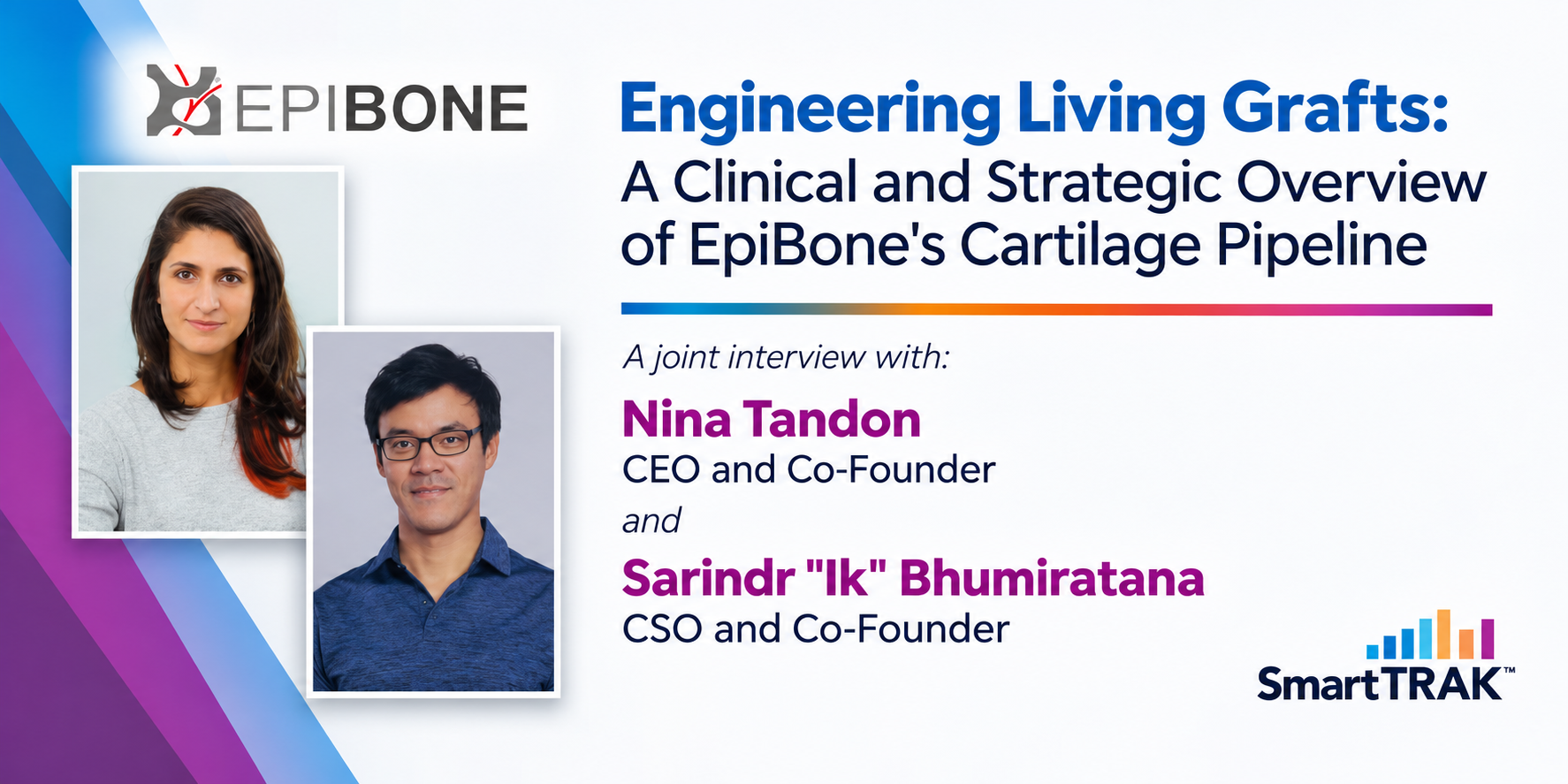
This interview with SmartTRAK features EpiBone co-founders Dr. Nina Tandon and Dr. Sarindr Bhumiratana. EpiBone uses tissue engineering, combining stem cells, decellularized scaffolds, and proprietary bioreactors to cultivate living osteochondral grafts. This engaging discussion includes an assessment of the clinical maturity of their cartilage pipeline, upcoming Phase 1/2b human trials, international regulatory strategies, and community-driven capitalization.
If you'd like to find out more, click on the following video (26:35 min). The complete transcript is below.
SmartTRAK: Awesome. Well, thanks for taking the time. I appreciate it. And I just want you guys to introduce yourselves and introduce EpiBone.
Nina Tandon: I'll go first, I guess. Hi, thanks for having us. I'm Nina. I'm the CEO and Co-Founder of EpiBone, and I'm joined by...
Sarindr “Ik” Bhumiratana:Sorry. Sarindr Bhumiratana, CSO, Co-Founder of EpiBone.
Excellent. Tell us a little bit about EpiBone.
SB: Go for it, Nina.
NT: Oh, yeah? Okay. Well, it's definitely a team effort. Ik and I started working together back in 2006 when we were grad students in a tissue engineering lab. And what we do at the company is we use stem cells, scaffolds, and bioreactors- so tissue engineering, canonical tissue engineering- to make... It's a platform to make living bone and cartilage for skeletal reconstruction. Is that fair?
SB: Yeah.
Now, bone and cartilage, that's a wide swath. Are there areas that you're concentrating more on? Is it more on the bone side, more on the cartilage side? Which areas are you really focused on?
SB: Yeah, the company started with anatomical bone for facial reconstruction, but as we moved along, basically that area proved the concept of using cells for a very complex reconstruction of facial bone. We have done a clinical trial on those. We have shown that it is safe. It can reconstruct facial bone. But now that is a very niche market. We started expanding and are now getting a lot of interest to go beyond just facial reconstruction, down to the body, down to joints, to regenerate osteochondral and cartilage tissue, and that has become more of a focus nowadays.
So, since we're at the ICRS meeting here in Porto, beautiful Porto, we got a nice little sunset going on behind us. Tell us a little bit about the work that you've been doing in the cartilage area.
SB: Yes. The first product is a tissue-engineered osteochondral graft, so it's cartilage on a bone piece. We have done animal studies, and now we have an IND, a US IND, clear to start human trials. We are in the process of setting that up and raising funding to begin the trial.
What's the timeline for when you will start that trial?
SB: Yeah, we're looking at some time next year.
Has there been any clinical work with the product at all at this stage?
SB: Not yet. Not in humans. We did a lot of animal studies.
Equine?
SB: One of which is an equine study with Cornell, with Dr. Lisa Fortier, who's also here. Yeah. So, it went very well. We can even say more about how great the team was. We give them the product, they implant it, they monitor everything and give us the result. And we are very excited about this product. Upon implantation and we monitored the product for 14 months in equine, and we saw good bone and cartilage regeneration and integration, resulting in completely integrated new tissues on implantation.
So, the equine model is a great model to utilize for this indication. What are the ways that you're designing the study to... What are you going to be looking at as far as outcome factors or outcomes in the human body?
SB: Yeah, what we did in horses is exactly how we look at humans. We assess pain; we review MRI; we review biologics, blood tests, and synovial fluid; and it has even been more extensive than what we would commonly do in human clinical trials. But with MRI and pain, we look at that very, very deeply to see what the results show. And we were comparing our product to a very high-standard osteochondral allograft, and the functional and safety outcomes are pretty much right on, closely matching those of an osteochondral allograft. We see that because our tissue is derived from mesenchymal stem cells, it integrates better with the surrounding tissue. So, the cartilage we see is fully integrated with the native cartilage, forming a single smooth surface.
NT: Yeah, we engineer the cartilage for four weeks in vitro, which is a short time and a long time depending on what you're measuring that against. Four weeks is not that long. So those cells are still quite young. And so, our hypothesis is that we're making tissue that's mature enough to function when it's implanted, but it's also immature enough to really connect and integrate. I think that was the most dramatic result for us. First of all, we were so happy to match the safety and efficacy of fresh osteochondral tissue, but the integration was what really made us super excited. The images are so beautiful, you almost can't see the border.
So, from a technology standpoint, there are an osteo phase and a chondro phase. Can you describe what those different phases are?
SB: Right. So, the product has tissue-engineered cartilage. So, the cartilage is fully grown from stem cells. We have a process that allows us to direct cells to produce hyaline cartilage. So, the product contains cartilage integrated with a bone scaffold. It's a decellularized-
NT: But not demineralized. Sorry, decellularized, not demineralized.
SB: So basically, it only contains collagen and minerals on that scaffold. So, we grow these osteochondral units by packing cells onto the scaffold. And these cells are very smart because, in the way they differentiate, they can sense where they sit, where they stand, whether they are inside the bone scaffold or outside the bone scaffold. And with the right nutrients and mechanical stimuli, we grow this graft in a bioreactor, giving it exercise and compression.
So, over time, the cells know, "Hey, I'm at the border between bone and cartilage inside the bone." They become more striated and more of an interface cell, as seen in extracellular proteins and gene expression. But the cells that are packed on top of the bone line become very hyaline and produce a lot of glycosaminoglycans, collagen Type II, and aggrecans. And even on the surface, there is lubricin, a surface protein. So, we see structural striation because cells at different locations in cartilage are in different environments, and that's how we get very nice, very beautiful cartilage fully integrated with bone, good for implantation.
So, one of the disadvantages of osteochondral grafts is that you don't know how sleepy the cells are or how alive they are. There may be some senescent cells in there as well, which can cause problems in the long term. Have you looked at any of the characteristics of senescence?
SB: Yeah, that's one thing that we look at all the time, very early on, at optimizing our bioreactor so that we know even the deepest cells in that tissue receive sufficient nutrients to continue to differentiate and make tissue. And that's how we designed our little bioreactor; we call it the culturing system.
NT: Yeah. We were really looking to make sure we were mimicking the body's blood supply. So, essentially, those first bioreactors are fluid-handling systems that allow not just the delivery of oxygen and nutrients, but also, when we're engineering bone, to stimulate cells to differentiate towards bone and lay down a matrix. And those shear stresses have to be within really tight bounds.
And because we were growing bones in all these different types of anatomical shapes, that's a non-trivial problem to make sure we're within those tight bounds of shear stresses that are strong enough to give that stimulus, but not so strong that they slough the cells off. So that was the kind of basic research that we did in the academic setting before spinning out. And it's really nice to see it in action now with more and more tissues over time. So that was something we cared a lot about. We didn't want to make a pancake of cells around a necrotic core. Just that would not be very satisfying.
So, it sounds like great scientific work. And of course, that may be the easy part next to the next question that I have, and that's the regulatory process. So where are we on the regulatory framework?
SB: Yeah, so cell product, it's considered to be a biologic. So, we are in the IND/BLA pathway. So, we have to go through clinical Phases 1, 2 and 3 as a biologic. So, we are in Phase 1-2, 1-2B in this trial. FDA has allowed us to go directly into 1-2B. So that's what we'll start with in this study.
NT: Yeah. For our bone product, the facial bone, we finished Phase 1-2A. The osteochondral has been greenlit for Phase 1-2B, and we have a Phase 1-2A for our injectable cartilage that we are currently enrolling.
Now, is the US the only market you're looking at, or are you looking at other markets as well?
NT: I think from a regulatory perspective, we filed our first non-US IND just last year, and that's been greenlit for a trial in Thailand, which is enrolling now. I think a lot of companies have been looking overseas to countries like Australia and China. But in our case, because we came from Thailand and we had Thai investors and Thai friends from our grad school days, it was a natural fit for us. And there's a lot of great clinical collaborative opportunities there. I mean, top medical schools; it's just a real gift.
SB: And it's about balancing the milestone data of human data and the money that we need to spend in different areas. At the end of the day, our focus is on the US, the largest market. But along the development pathway, or in clinical trials, there are certain areas first in humans for certain products or indications. If we can get a proof of concept more cheaply or faster, we want to explore that approach and try it out. And this is where we go with the injectable cartilage in Thailand right now: "Let's try it out. Let's conduct a good study at a good medical center and bring that data to the US."
So, the regulatory landscape in the US is changing significantly as the administration changes.
NT: Yeah, for sure.
Now, a number of states have broken ranks in some respects and are running their own Right-to-Try initiatives. Florida has passed a stem cell law.
NT: That's right.
Is that something that you're engaged in? And if so, can you tell us how that's going?
NT: Well, we certainly find it very interesting and mostly a positive signal. We started looking abroad to conduct clinical trials for some of the reasons I just mentioned. We wanted to find any way to accelerate the time to patients. And we like working in highly regulated environments because that is good for patients and also for competitive advantage.
However, I think I probably wouldn't invite much criticism or controversy if I were to say that there are ways we can learn from other... The US can learn from other geographies for smart ways to speed things up. And I think that the same thing... And I'm glad to see that's happening in the US. And in the US, it's very interesting. So Ik talked about how we explored in Thailand. I also spent some time in the United Arab Emirates, which is another interesting geography with high clinical standards, but variations on a theme in terms of the business model.
You mentioned Right to Try here in the US. I think what makes that so interesting is it's part of a pattern within the US of, oh, there are 50 countries in the US. And the dialogue and the balance of power between them can often serve as a competitive force that pushes everybody along. And so, Right to Try that we're seeing now, where there's a lot of, I think 17 states now, where technically EpiBone would be legal in them, something like this, it's a version of Right to Try from 15 years ago. It took 41 states before the federal government moved in that direction.
So, for us, it's an important movement, an important signal, and it indicates where the country's going. And where that is going is hopefully towards an equilibrium where, in Phase 1, getting first in human, some of those barriers that are unnecessary might be taken away, taking advantage of certain technologies like AI and technologies like being able to build cellular... Using tissue engineering to build cellular models and avatars that can reduce the need for not just human testing, but in non-clinical testing as well.
So, I think it's a good movement. We're not going to be launching products in defiance of the federal government anytime soon. But we are paying very close attention to it, because I think, like in the past, I think it's a signal for where the country's going. And I think that's a good thing. We want regulation. I think we're not alone in that, but we want the regulation to be smart, and I think that's where we're going.
SB: And in addition to that, I think we are looking at this Right to Try as very interesting. We haven't gone into it fully, but we are thinking that if we were to utilize this, we want to do it right and make sure that we are not cutting corners. We want to do good studies, getting clinical-level data as we are seeing at ICRS here. It's always about good clinical trials, good comparisons. So, if the Right to Try helps push it along with good studies, we are exploring if there's a benefit to those. Otherwise, we go to the FDA and conduct a study.
Now, in your conversations with the FDA, have they tipped their hand a little bit as far as letting you know what the pivotal trial is going to look like, size, comparators, anything along those lines?
NT: They give us indications. I mean, there are certainly guidelines and studies that show how real-world evidence has been incorporated more and more, especially in device approvals. There's great guidance on that. And I think even though... And the FDA has also said they have never prosecuted a Right to Try case.
Now that said, I think our view is we like regulation and we want to be proactively compliant and set a good example and get good clinical evidence that will stand up to scrutiny. And so, we're actually really interested in the federal version of this state Right to Try, because as much as you talked about how, "Oh, the states are doing this and that," well, it's interesting for us to look and see, well, how different they actually are in practice.
And for us, I think it's really given us inspiration about how much of the Right to Try ethos is already baked into the current regulatory framework. So, I think it's more than just encouraging us to misbehave; it's encouraging us to really see and, I would say, proactively comply with the spirit of the law. Because I think what we're seeing now is certain regulations being shifted, but the spirit is, "Well, how do we efficiently, correctly meet our mandate?"
I think you said it best: "We're all on the same team in this field." Whether we're clinicians, industrial partners or patient advocacy groups, we all want the same thing.
So funding is another big thing. You’ve taken an interesting approach. I don’t think I’ve seen too many folks who have taken the same approach, and it’s doing community funding. So, you’re working with WeFunder.
NT: I feel like when you start a company, coming out of school, we were two cheerful postdocs with MBAs who and worked in industry for several years. But the world that's handed to us or explained in textbooks is very different than the world of the school of hard knocks, if you will.
True.
NT: And so, I think one thing that I think we found out pretty early was that the coalition that comes around this type of technology is just not going to look like your regular old enterprise, SaaS, VC-funded company.
True.
NT: Because it turns out living cellular therapies that live in our bodies for the rest of our lives are just- it's not enterprise software. And so, the unit economics of the unit, whether we're being compared to other startups in tech or being... We're med tech, but what are we? We're in between tech and biopharma. And there's a biopharma playbook of you do Phase 1, Phase 2, Phase 3, and your data go up along with your valuation. Every time you meet a regulatory stage gate, your valuation automatically goes up and up and up and up.
And those laws of gravity, as they're presented to us, aren't exactly how things work. And I think something about the fact that we're a tweener technology where we make three-dimensional therapies that are not a device, and we are a biopharma company that's not treating oncology or other... And I love how so many people at the meeting here said life-threatening in finger quotes, because I think that's a pejorative that is used for MSK all around, when really we know from the data, and everyone knows from their personal lives, from their friends, that when you have a condition like pain, it couldn't be more similar to something life-altering.
And that's the real difference between Right to Try 1.0, which was all about lifesaving end-of-life care. We're seeing that movement now, where people are starting to recognize chronic and debilitating conditions, like musculoskeletal conditions, that dictate how much we want to live our lives. And we call it “quality of life” as if it's a number, but it really is so meaningful.
And so, being in this in-between med device and biopharma, we always had to find our own way. And the coalition that kept building around us was always... And that's the pattern that has stuck. It's always been people who suffer from conditions we aim to treat, the clinicians who treat them, and the number of orthopedic surgeons on our cap table is significant. The hospitals that were moving up the food chain, the hospitals where those physicians work. But has it been a traditional... And the athletes, I guess that's the first bucket.
And so now, it was just a natural extension. We had more and more patients coming to our door seeking treatment, and we said, "Okay, well, look, this is the coalition."
And it's smart money, because it's the people who know, who feel the pain and feel the pain points that we're trying to solve for. And so, we just said, "Let's lean into that."
I would say another non-traditional source of funding we've pursued has been military contracts. We said, "Who are the gladiators of our age?" It's the people, the professional athletes, the troops. Those are all people who stand to gain from technologies like ours. So that was one non-traditional source of funding we went after.
We went after angel groups of orthopedic surgeons, patients, athletes and professional athletes. It's kind of taken on a life of its own, because it's this engagement machine with the people. It's just the people we aim to serve. And they're coming to us- the conversations we are having now, the collaborative opportunities that have been sparked from orthopedic surgeons coming into the syndicate- it's been really amazing.
SB: Yeah. And as it all starts to shift, we think we have been focused a lot on lifespan. Everything is about living longer, living longer. But more recently, people are talking about health span now.
NT: Yeah, health span now.
SB: And I think this is where musculoskeletal, or these orthopods, are seeing that people who live longer don't have good health.
NT: Yeah, if we're... And the other statistic that keeps coming up at this meeting, which compounds that, is people getting injured at 15. I mean, there were statistics that were spoken about today with-
SB: OA in 40s and 50s.
NT: Yeah. So, if kids under 18 are specializing in sports and getting injured, and then we're going to live till 115, we need our implants to last longer than they do.
SB: And then, people who understand health span as regular people nowadays are people who see patients every single day, and that's what community rounds brought us to see.
I talked to Dr. Giuseppe Filardo about this very topic, and he informed me, and I didn't know this until I talked to him, that more and more people are having arthroplasty at younger and younger ages. And that is setting the stage for a catastrophic bomb of revisions later on down the line.
NT: You said it.
If you're doing things like this where you're not burning bridges, you're giving a biologic approach, and I know that's what ICRS is all about is creating and empowering technologies to come out and get out on the market that are able to do this. And we're all after getting out of metal until it's time, until you get to a stage where you just can't do anything else at an appropriate stage, when the patient is a little bit older.
So right now, the FDA has only one approved cartilage technology that's on the market, MACI. And how do you compare to that? What's your sell against with the behemoth, the 800-pound gorilla in the room that is MACI?
NT: Vericel, yeah. I mean, we admire them very much. I mean, I think it should be said, MACI's a second-generation product built upon Carticel, and they've really paved the way for cell therapies to be used in MSK, true cell therapies, not stem cell injections. And I think it also proved that those types of technologies can be reimbursed at healthy rates by insurers.
And if MACI was going to be done now, which is why I say where I think we come along is we do know that chondrocytes don't make as good cartilage as stem cells do. So, our technology goes a little bit further up the lineage and starts with the ingredients to make better cartilage. So I think that's one thing that we are proud of with our technology.
We also, as Ik mentioned, engineer the cartilage on top of a layer of bone. That bone, we know, anchors the tissue in and provides a template for all those beautiful layers of striations to develop. I do want to correct you, though, ever so slightly. There is another product, too, and it's here as well. So, there's Vericel, but there's also CartiHeal, and CartiHeal is a device. I think that also speaks to this difference. It's an acellular device, and MACI is cellularized but doesn't have that structural component.
Sure.
NT: And so, if I were to say where I think we really come in, it's that we believe you need the cells and you also need the structure. So, we're proud of our osteochondral graft. And because we have a platform technology, we have a version of that cartilage that can be introduced non-invasively. So, I think we're proud of what we've done, but it's science. We're standing on the shoulders of giants. So, I think we're really collegial with these folks and really proud that they've helped move the needle for patients.
Well, thank you. I appreciate you taking the time.
SB: Yeah.
NT: Thank you. Real pleasure.
Want more insights like these? SmartTRAK combines expert interviews, in-depth articles and real-time daily market updates with data and analysis covering orthopedics, wound care, regenerative medicine and neuro therapies. From emerging technologies and competitive developments to company revenues and market shares, discover how SmartTRAK’s industry experts help you stay informed, identify opportunities and make more confident business decisions. Click the button below to learn more.
SmartTRAK is the Medtech industry’s only global Insights-as-a-Service solution for the Orthopedics, Wound Care, Regenerative Medicine and Neuro Therapy markets. SmartTRAK’s proprietary methodology turns disparate data from hundreds of sources into powerful insights customers can rely on as the trusted source for strategic decision-making. The SmartTRAK enterprise platform includes rich daily updates, comprehensive market coverage and simple-to-use tools and dashboards for market, product and financial analysis. Customers leveraging the SmartTRAK platform also have direct access to mkt experts for inquiries and advisory services. If you would like a demo of what SmartTRAK offers and how we can help increase efficiency, improve productivity and reduce costs for your company, just click here.